Finding the “why” behind slides
Action
UX research to evaluate instructional materials.
Impact
Higher quality curriculum materials used across our B2B enterprise and B2C programs, more efficient time allocation for curriculum creators, and a higher level of design maturity within our organization.
Skills: user interviews, stakeholder interviews, usability tests, survey design, heuristic evaluations, competitive analysis, thematic analysis, quantitative and qualitative data analysis, data synthesis, workshop facilitation, ux design, project management
Note: Some content on this page has been generalized, recreated, or omitted to comply with confidentiality agreements.
Summary
Impact
- Product team members reallocated their time more effectively
- Instructional materials were updated to suit differing needs across instructors and students, creating a more tailored and optimal learning experience
- Improved materials used across all our programs: B2B enterprise and B2C
- Increased design maturity for our organization by sharing knowledge and design practices
- Demonstrated one of our company's annual objectives: be more data-driven
Context
My company's main product: B2B and B2C technical training programs for upskilling or career-switching adults to learn software engineering, product design, and product management.
My role: As the sole Product Designer in my company, I managed and conducted the entire UX research process on my own. Solutions were collaboratively identified with my team (Product), and implemented by the relevant team members.
I identified a research opportunity lurking behind the core assumptions that were driving my team's approach to creating slide decks, and other instructional materials.
Process
I combined a variety of research methods to collect a mix of quantitative and qualitative data, and segmented my participants into the different types of users who used our slide decks and other instructional materials: students, instructors, and Product team members.
Key insights
The foundational issue: different participants used the slide decks for different purposes. Different purposes = different needs. And different needs require different solutions.
Solutions
We decided to separate concerns across different curriculum materials by creating dedicated study guides for students, and lecture guides for instructors. We also started referencing our curriculum's critical concepts checklist for each topic when creating slide decks for it.
Deep dive
Context

The company
My company's main product: B2B and B2C technical training programs for upskilling or career-switching adults to learn software engineering, product design, and product management. The Product team was tasked with creating the curriculum and instructional materials used in all these programs, including programs taught to our global enterprise automotive client.
My role
Job title: Product Designer | Teams involved: Product, B2B Instruction, B2C Instruction
As the sole designer in my company, I managed and conducted the entire UX research process on my own. Solutions were collaboratively identified with my team (Product), and implemented by the relevant team members.
A designer's favorite question
"Can you make it pop?"
(Just kidding).
When I joined the Product team as my company's first full-time, in-house Product Designer, I had a lot of questions. What is this project about? Who do I go to for this ask? How do I carry out this process? Why is that done this way?
The last question – the "why" question – is the type that can often go unspoken. No one wants to seem rude, and a good "why" requires a delicate wielder. A good "why" allows us to explore a topic with open curiosity. A bad "why" is premature critique disguised as a question.
The love of an innocent, unassuming "why" unites designers and toddlers around the world. We love to ask it! And asking "why" repeatedly is how I found myself leading a multidisciplinary UX research study on slide decks.
Why slide decks?
As I got to know the Product team, I made the following observations:
- Slide decks were the medium most often used for our teaching materials
- Creating, updating, and improving slide decks was a huge, recurring time commitment for most members of the Product team
- Slide decks were used as supporting media for our other materials, like prerecorded lecture videos
- Slide decks were showcased as key materials to advertise our programs to prospective B2B clients
- Slide decks informed what instructors taught… and therefore, what students learned
Considering each point above, I found myself asking: why slide decks?
As I went down this line of questioning, I identified a research opportunity lurking behind the core assumptions that were driving my team:
- Slide decks are important
- We already know how instructors and students feel about our slide decks
- We already know what instructors and students need from our slide decks
It was time to test these assumptions.
Process
Research and data analysis
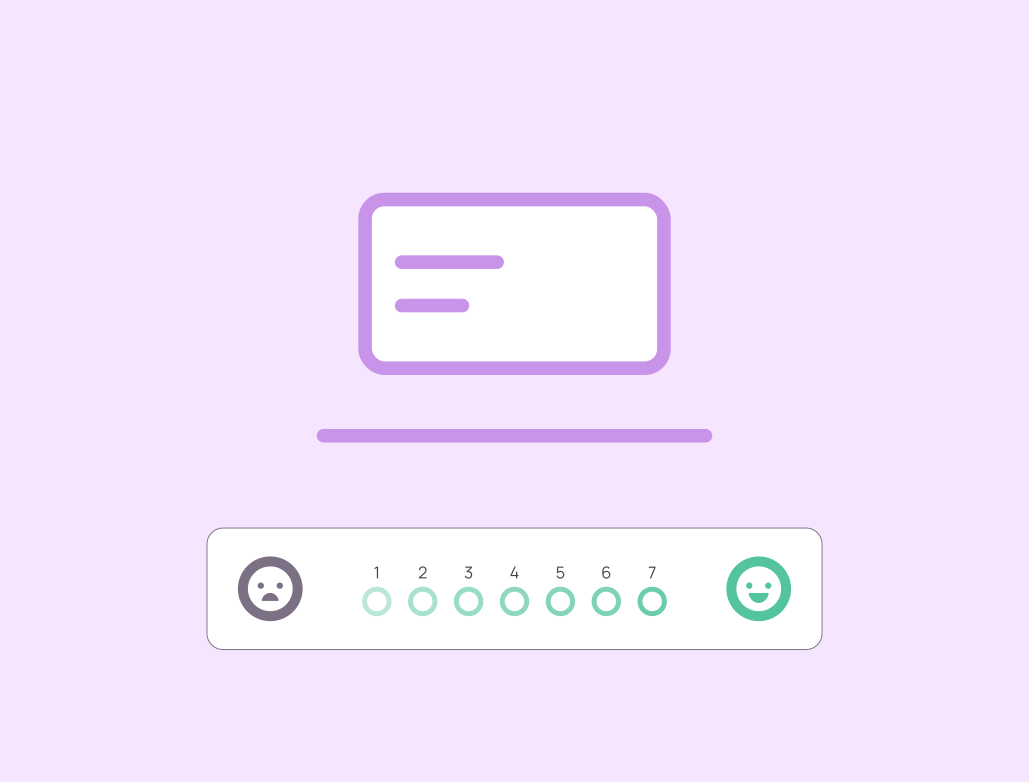
I combined a variety of research methods to collect a mix of quantitative and qualitative data, and segmented my participants into the three types of users who used our slide decks and other instructional materials: students (6 participants), instructors (4 participants), and product team members (2 participants – team members who created curriculum materials). Across all three groups, I included both first-language English (FLE) speakers and non-FLE speakers.
Research methods:
- User/stakeholder interviews
- Usability tests
- Custom survey (designed by me)
- Standardized "User Experience Questionnaire"
- Heuristic evaluation
- Competitive analysis
Analysis methods:
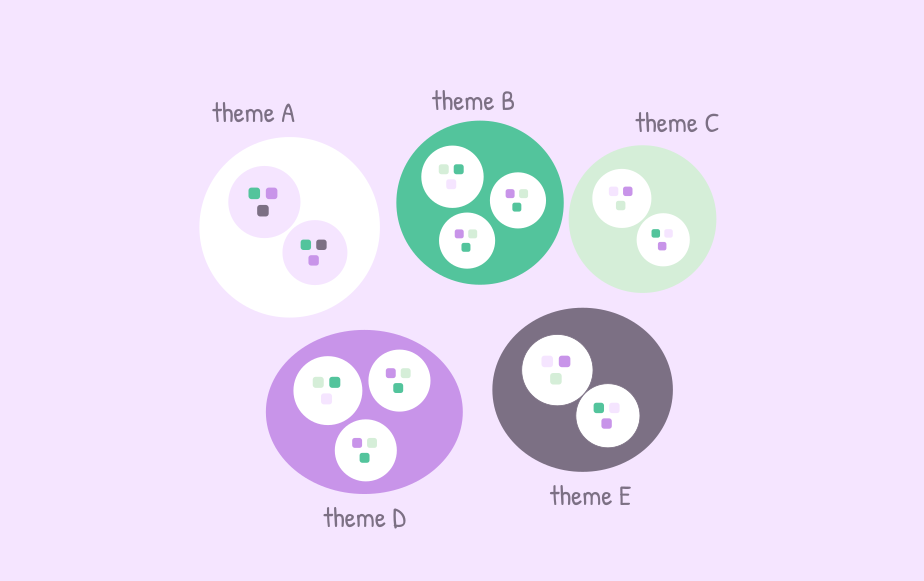
- Thematic analysis
- Data synthesis
Bias mitigation
An inherent limitation of this study was the potential for bias to creep in from the sole human interpreting all this data (me). I was also not able to include participants to represent every single program, as access to our enterprise B2B clients was limited.
I mitigated the above limitations by:
- Designing questions that were non-leading
- Having another Product team member review the questions I used across the interviews, usability tests, and surveys
- Referring to interview transcripts to reduce recall bias
- Conducting a total of 12 usability studies, which safely exceeds the design research benchmark of testing with 5 users to uncover approximately 85% of usability problems
Key insights
What we learned
The findings confirmed my team's first assumption was correct: slide decks were, indeed, important.
However, the findings also told us we were wrong about our other assumptions: we didn't know how everyone felt about our slide decks, and we didn't understand the full scope of their needs.
"The data was incredibly useful to me, because it disproved some of my feelings about what was most important to focus on." – Product team member
Main findings:
- Many participants want more information on slides
- Many participants want less information on slides
- Many students use slide decks for study and review after class
- Many instructors rely primarily on slide decks to prepare for lectures and workshops
Some findings seemed contradictory, and at first glance, indicated problems that seemed impossible to solve. More information or less? Which group do we cater to? Favoring one would disadvantage the other.
But the findings also drew attention to a more foundational issue: different participants used the slide decks for different purposes. Different purposes = different needs. And different needs require different solutions.
The takeaway
So far, the slide decks were doing it all (and apparently, doing too much).
They served as:
- Lecture and workshop presentations (for students and instructors)
- Study guides (for students)
- Lesson plans (for instructors)
What a heavy burden for slide decks to carry! The reason they were created in the first place was to serve the first need: instructors and students both needed visual materials to aid the classroom experience. But somewhere along the way, it had become an unwritten rule for the Product team to use slide decks to meet these other needs, too.
Solutions
After I shared these insights with my team, we discussed and evaluated them together.
Next, I led a design workshop. Here, we identified:
- What we were already doing, that we wanted to continue doing – backed by research
- What we wanted to do differently
What we decided:
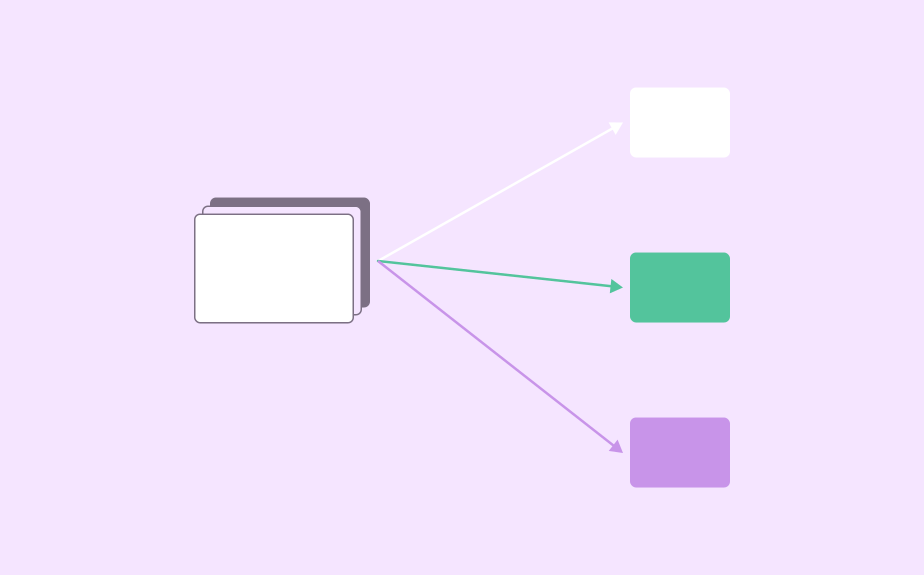
- To separate concerns across different curriculum materials
- Create study guides that provide detailed information for students that want it
- Let slide decks prioritize high-level information only; keep information that is just for instructors in speaker notes
- Create separate lecture documents that provide detailed guidance for instructors on how to run a lecture or workshop
- To refer to the critical concepts checklist for a topic when creating slide decks for it
- This is something we already had in our curriculum for each topic – this was the perfect tool to keep our slides focused, but we had forgotten to make use of it when creating new decks
Other improvements included splitting multi-topic slide decks into separate decks, and recording more videos as learning material for preparing instructors and studying students. I also created a template and style guide for our slide decks, tailored for each program.
Constraints
This was a fast-paced, start-up environment, and I was the sole designer in the organization. As a result, I quickly had to pivot away from this project to another one before I had a chance to carry out further research and allow room for iteration. If I had a chance to revisit this project, I would conduct follow-up surveys and interviews with students, instructors, and Product team members to validate the success of these solutions, and identify further improvements to be made.
Impact
What did we gain from all this?
I was able to observe several positive changes myself, and through direct feedback from my team, my manager, and coworkers outside my team.
For the Product team:
We gained time, and a better strategy to allocate that time. We no longer wasted time working on slide decks without first considering what type of information was best suited for each format. If we had not done this research, our curriculum creators would have put a lot of effort into creating and updating slide decks, without much payoff in terms of how effective this material was to students and instructors.
"If we had jumped straight into the work as an 'experiment', we would have committed way more time and effort before arriving at the same conclusion that the research did." – Product team member
For students and instructors:
Material was provided for them in different formats to prepare or learn from, creating a more tailored and optimal learning experience.
For the company:
These improvements were made for materials used in both our B2C programs, and our enterprise B2B clients. Wide-scale adoption meant wide-scale impact.
I was also encouraged by my manager to present this project during one of our company-wide knowledge sharing sessions. Sharing this research helped raise the design maturity of our organization, and furthered one of our annual company objectives: to be more data-driven.